
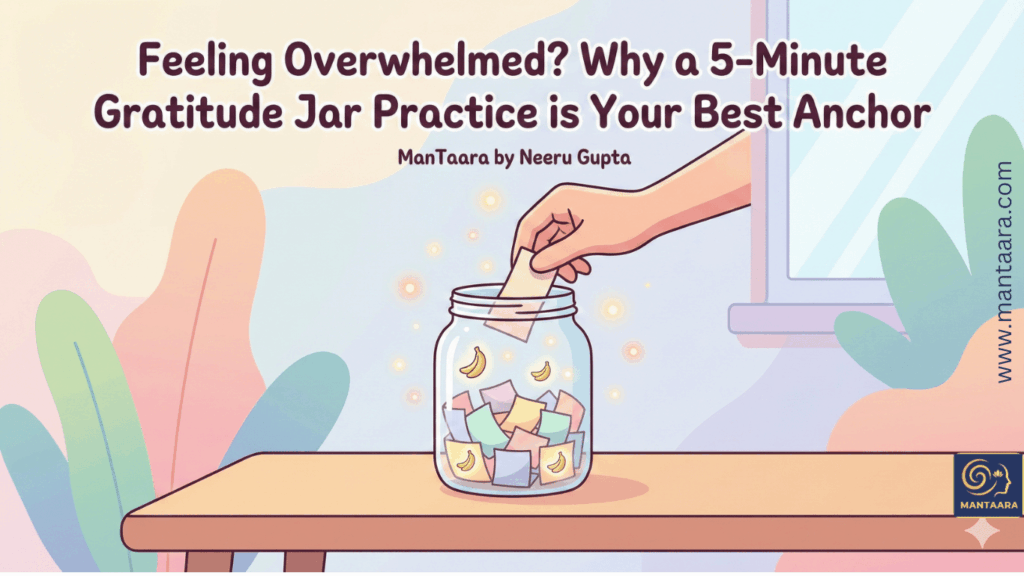
When you feel suffocated by daily stress, your brain often loses its ability to see the small wins. This is where a consistent gratitude jar practice becomes essential. As a counseling psychologist, I have seen how this simple 5-minute ritual acts as a cognitive anchor, pulling you back from the “hype” of an emotional spiral and grounding you in reality.
Before we dive into how to build your jar with ManTaara‘s handholding, take a moment to pause and let these questions sit with you:
- Do you feel like you are running on a treadmill that won’t stop, even when you’re physically sitting still?
- Does a minor daily setback—like a spilled tea or a sharp word—feel like a major catastrophe lately?
- Are you struggling to find “mental breathing room” under the weight of your daily to-do list?
If you paused for a “yes” for any of these, you aren’t just tired; your nervous system is likely stuck in high-alert mode. At ManTaara, we focus on finding “Safe-Sparks”—tiny, often fleeting moments that signal safety and calm to your brain. These aren’t loud celebrations; they are quiet reminders that you are okay, right here, in this moment.
Beyond Positivity: Why a Gratitude Jar is Your Physical Anchor
In my 25 years as a freelance counseling psychologist, I have learned that gratitude is not about “thinking happy thoughts” or ignoring the very real pain you may be feeling. It is a psychological skill—the ability to acknowledge the goodness currently present in your life, even when it feels small or hidden.
The True Importance of Gratitude
Practicing gratitude isn’t just a “feel-good” activity; it is a way to build resilience. By acknowledging what is still working, you are reinforcing your own Character and Competence, which are core focus areas we use at ManTaara. It shifts your perspective from what you are losing to what you still possess.
The Power of the Physical “Jar”
So, why a jar? Why not just a mental list? A gratitude jar practice offers something a thought cannot: Physicality.
- A Cognitive Anchor: Abstract thoughts are easily swept away by stress. A jar provides a physical home for those moments of relief, acting as an “anchor” that holds your attention.
- Visual Evidence: On days when you feel “dead tired” or discouraged, seeing the jar slowly fill up with notes provides visual proof that goodness is accumulating in your life.
- The “Neuro-Scribe™” Effect: The simple act of handwriting your “Safe-Spark” and dropping it into a container makes the thought tangible. At ManTaara, we believe this intentionality helps move the memory from a fleeting moment into a lasting asset.
How to Use the ManTaara Method: The 5-Minute Scan
At ManTaara, we believe that a gratitude jar practice shouldn’t feel like another heavy chore on your to-do list. Instead, we use a technique called the “5-Minute Scan”. This isn’t about waiting for a life-changing event; it’s about training your brain to notice “Safe-Sparks” that are already present in your day.
The Three Focus Areas
When you sit down with your jar, don’t just ask “What happened?” Instead, scan these three specific areas of your life:
- Connection: Did you feel a sense of belonging today? Even a short text from a friend or a quiet moment with a family member counts.
- Competence: Where did you feel capable? It could be finishing a difficult email or applying your professional skills to solve a small problem.
- Autonomy: Where did you have a choice? Maybe you chose to take a break when your body asked for it, or you worked at your own pace without pressure.
Level 0: The “Survival Glimmers” for Tough Days
We all have days where we feel “dead tired,” in pain, or completely suffocated. On these days, the “big wins” feel impossible to find. That is when we turn to Level 0 Glimmers—the foundational Safe-Sparks that remind us we are still okay:
- “I am still breathing; the air around me is free and sustaining.”
- “I have my skills and my wisdom; no one can steal my internal knowledge from me.”
- “I have at least one person who knows my name and cares.”
- “I have the safety of a roof and the warmth of a simple cup of coffee.”
By dropping these small “anchors” into your jar, you are proving to your nervous system that even on the hardest days, goodness is embedded in between the struggles.
The Psychological Edge: Why Writing Matters
Our brains are biologically wired with a “Negativity Bias”—we notice the one thorn in a bush of roses much faster than the flowers. This survival mechanism helped our ancestors stay alert to danger, but in the modern world, it often leaves us feeling suffocated by stress. A consistent gratitude jar practice acts as a counter-weight to this bias, training the brain to scan for safety rather than just threat.
The Neuro-Scribe™ Connection: The Power of Handwriting
At ManTaara, we emphasize the act of writing your Safe-Sparks. As a graphologist and psychologist, I have seen how the sensory involvement of handwriting deepens the brain’s retention of a memory.
When you use the Neuro-Scribe™ approach to document your gratitudes, you are doing more than just making a list:
- Sensory Engagement: The physical movement of the hand creates a stronger neural pathway in the brain than typing on a screen.
- Mental Pause: Writing forces you to slow down, allowing the emotional “glimmer” of the Safe-Spark to actually register in your nervous system.
- Tangible Evidence: Each note in your jar becomes a physical “anchor” of your resilience and character.
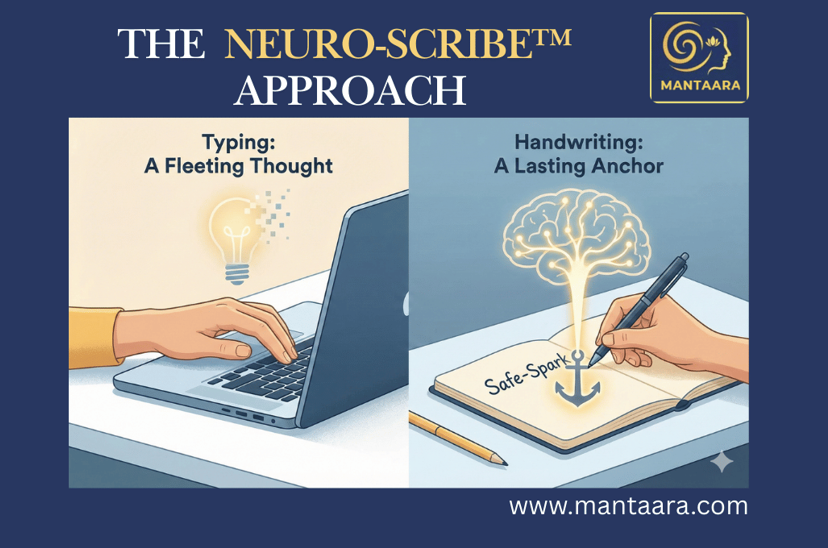
[ Hand-writing vs Typing Image ]
The Neuro-Scribe™ Effect: How handwriting acts as a neural anchor for your well-being.
Struggling to Start? Let’s Anchor Together
I understand that when you are in the middle of a “Mood 3” day or feeling physically exhausted, even a 5-minute worksheet can feel like a mountain. Sometimes, a template isn’t enough—you need a partner to help you find the light.
If you find it difficult to enact this practice on your own, we offer a specialized “Gratitude Handholding” Package:
- 3 Personalized Sessions: We work together to identify your unique “Focus Areas” (Connection, Competence, Autonomy).
- Guided Scanning: I help you navigate through the “gray” to find the Safe-Sparks you might be missing.
- Neuro-Scribe™ Integration: Learn how to use remedial writing techniques to make your gratitude practice a permanent part of your emotional DNA.
Sometimes, the best way to build an anchor is to have someone help you drop it into the water.
Your Next Step: Drop Your First Anchor
Ready to start your own gratitude jar practice? You don’t need a fancy container or hours of free time. All you need is the willingness to notice one small Safe-Spark today.
Download Your Free 7-Day Gratitude Anchor Worksheet
To help you navigate your first week, I have designed a specialized worksheet that guides you through the “Scanning” process. It includes space to track your mood, identify your Focus Areas (Connection, Competence, Autonomy) and record your glimmers.
[Download the 7-Day Gratitude Anchor Worksheet Here]
Let’s Connect
I would love to hear about your journey. Which “Focus Area” felt the most meaningful to you today? Did you find a Level 0 glimmer that helped you get through a tough moment?
- Leave a comment below and share your first “Safe-Spark” with our community.
- Need more support? If you are feeling stuck or find it hard to enact this practice on your own, please Contact Us to learn more about our personalized 3-session “Gratitude Handholding” package.
As a counseling psychologist with over 25 years of experience, I am here to help you move from feeling “suffocated” to feeling steady. At ManTaara, we believe that even in the heaviest of times, your “Mind-Stars” are still shining.
Always remember: Happiness is just around the corner, waiting for your attention.